
Streeting sets out his stall for a progressive capitalism that will get Britain building again
Posted: 17th June 2026

Graham Watts OBE
Chief Executive
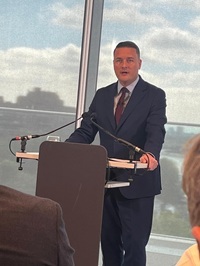
I was privileged to be the only representative of the built environment sector invited to hear Wes Streeting lay out his stall for the progressive capitalism that would be at the centre of a Labour government led by him, during a wide-ranging 40-minute speech from a podium framed by views of Tower Bridge.
Streeting set out a stall for a progressive capitalism fuelled by social democracy in a speech that was critical of the current government that he was until recently a part of, especially in what he described as a failure to prioritise. He deplored the recent dictat to reduce spending across every government department by 1% since it was the exact opposite of making difficult choices; he also criticised the decision to announce £4.5 billion of public spending on “walking and cycling” the day after the defence secretary had resigned due to the government’s inadequate funding of the country’s security, arguing that the public would know which of these was the real priority.
“Fiscal policy and monetary stability are non-negotiable”, he told the invited audience of around 60. He believes that small “thoroughbred” firms, often those that spin-out of universities, at the front end of high-growth AI, advanced technology and manufacturing, life sciences and the creative industries should become the spearhead for “a new industrialisation in every part of Britain”.
He advocated for a pro-growth and pro-fairness agenda, acknowledging that the tax burden in Britain is too high. He pledged to move taxation away from employment and onto wealth without providing any specifics. Surprisingly, in laying out his economic agenda, he praised the pro-growth and pro-fairness agenda of that “well known socialist” Nigel Lawson in equalising capital gains and income tax rates while being more generous to genuine investment. He also pressed for welfare to be a springboard back into work and not just a safety-net.
He confirmed that he has the necessary support to get onto a leadership ballot and said that he had not triggered the ballot to avoid jumping the gun on Andy Burnham. He hoped that if Burnham is successful at Thursday’s Makerfield by-election that the prime minister would set out a timescale for a leadership election without the need for it to be triggered by a contender.
Central to Streeter’s economic policy is a mandate for cheaper electricity that would make warming homes cheaper and remove a fundamental blocker to business and industrial growth. “Electricity must become a cheaper, easier and more reliable choice… we should show the world that net zero is compatible with a pro-growth agenda”. He also made it clear that “British capitalism suffers from a lack of competition”.
His recipe is for progressive capitalism that will “help Britain grow again” and tackle what he described as the “productivity desert”. He acknowledged the failure to build enough homes and said that this was “no longer a housing or social failure, but a growth failure”. He argued for more radical planning reforms, more freedoms for city centre and small-scale developments and stronger national decision-making on big sites, pressing for consequences on councils that fail to build. He also called for bringing empty units back into use.
If prime minister, he pledged to bring forward emergency infrastructure legislation to fast-track nationally important energy, grid, transport and infrastructure needs. “Clean power, lower bills, new homes, AI and industrial renewal all depend on Britain’s ability to build so let’s get Britain building again”.
On defence his core argument was to match increased investment with modernisation and to fund increased funding by “pro-growth choices”. Britain should become the “world’s most attractive destination for researchers, engineers and entrepreneurs, he argued, through a global talent programme “to recruit 20,000 scientists, engineers and AI experts over the rest of this parliament”.
Among other commitments in his speech was pressing for closer links to the EU and creating a sponsor body for care workers. If successful he pledged himself to a commitment to the manifesto that the Labour government was elected upon. Streeting concluded by asserting that “Britain must become easier to build in, and easier to innovate in”.
Acknowledging that he is far from being favourite in a leadership election, he described himself as the “plucky underdog” fighting with new ideas against the establishment. He argued that the election should be fought on ideas and not personalities and consistently refused to criticise Burnham, confirming that he had been in Makerfield on the previous day (15 June) campaigning for the man who had been his immediate Labour government predecessor as Health Secretary, acknowledging that Burnham had been very helpful to him in his first months in the role.
Despite a concentration on generalisations rather than detail, Streeting successfully projected an air of authenticity, comparing himself to the flip-flopping changes of priority in the current government by saying that he would set out his stall and stick to it. “People may not agree with me, but they will know where I stand,” he asserted.
Given the economic and fiscal fundamentals of his speech, I’m not so sure that it was setting out his stall as a wannabe prime minister, as much as it was laying down a marker to be the next Chancellor of the Exchequer.
Graham Watts OBE
Chief Executive
Graham has been involved with CIC since 1989. Initially, as a member of the Council, it’s Executive Board and then as a Director. He was appointed Chief Executive and Secretary in October 1991. Prior to joining CIC, Graham was Chief Executive of the British Institute of Architectural Technologists (a member of CIC) from 1983.
Graham is responsible for the general policy and direction of the Council, for maintaining effective communication with Government, other external agencies and with members and for establishing and maintaining the CIC Secretariat and office.
Graham is an Honorary Fellow of RIBA, CIBSE, CABE, ICWCI, BIID, CICES and the Faculty of Building and an Honorary Member of the RICS and CIAT. He was awarded the President’s Medal of the CIOB in 2000 and the Peter Stone Award of the Association of Building Engineers in 1996.
Graham is currently a director of CIC Approved Inspectors Register (CICAIR Ltd); Construction Umbrella Bodies (Holdings) Ltd; the Considerate Constructors’ Scheme; and Constructionarium Ltd. He was a Visiting Professor at the University of Northumbria for twelve years from 2000. He has been Secretary of the All-Party Parliamentary Group for Excellence in the Built Environment since 2010.
Graham is a member of the Industry Response Group, set up by the MHCLG in the immediate aftermath of the Grenfell Tower tragedy and Chaired the Competence Working Group set up to assist Dame Judith Hackitt’s Review of Building Regulations and Fire Safety. Following the report publication he is now Chair of the Steering Group charged with implementing the recommendations on improving competence for all those engaged in designing, construction, managing and maintaining higher-risk residential buildings, this includes oversight of the competence work being carried out in the Fire and Rescue Services.
Graham had a long involvement in the sport of fencing and his competitive career culminated with a Commonwealth Medal in 1990. In 1992, he captained the British Sabre team at the Barcelona Olympic Games. He was the Manager of the British Fencing Team from 1996 and the Performance Director of the British Olympic Fencing Team for 10 years from 2000 to 2010, and Team Leader at the 2004 and 2008 Olympics Games.
Outside of CIC, he is an established international dance writer and critic. He is a member of The Critics’ Circle, the UNESCO Dance Council, Dance UK and the Society of Dance Research. He has been Chairman of the Dance Section of the Critics’ Circle since 2009 and of the National Dance Awards since 2010. In 2012, he was author of Daria Klimentová’s Autobiography “Agony and Ecstasy: My Life in Dance”.
Graham received an OBE in the New Years Honours in 2008 for his services to the construction industry.
Share this story:
Contact us:
Telephone: 020 7399 7400
Email: enquiries@cic.org.uk
Read more:
- Apprenticeship Assessment Reform: What Built Environment Professionals Need to Know
- Two institutions, one shared goal: Championing civil engineering surveyors
- A Defining Moment for Project Safety: Competence, Clarity, Culture and the Road Ahead
- What Does the Future of Planning Look Like? Engaging the Next Generation and Beyond
- Build a happier, productive, and more efficient workforce, ready to deliver at scale